
A smart city leverages connected sensors, data analytics, and digital infrastructure to improve municipal services, optimize resource use, and enhance quality of life for residents. Kansas City’s smart city initiative, launched in 2016 with a comprehensive streetcar corridor deployment, has become one of North America’s most studied urban technology implementations, offering Canadian municipalities a compelling blueprint for scalable digital transformation.
Kansas City deployed 125 blocks of connected infrastructure including free public Wi-Fi, interactive kiosks, smart streetlights, and environmental sensors throughout its downtown core. The project generated measurable outcomes: pedestrian traffic increased 13% in equipped zones, parking efficiency improved by 20%, and the city collected granular data on air quality, noise levels, and foot traffic patterns. More significantly, Kansas City made its entire platform and data openly available, creating a replicable model that addresses a critical challenge for Canadian cities: how to implement smart infrastructure without vendor lock-in or proprietary constraints.
For Canadian decision-makers evaluating smart city investments in 2026, Kansas City represents a middle-market success story particularly relevant to cities like Winnipeg, Halifax, or Saskatoon. The initiative demonstrates how municipalities can deploy foundational sensor networks, establish open data protocols, and build public-private partnerships without requiring megacity budgets or populations. This article examines Kansas City’s specific technical architecture, analyzes which components transfer effectively to Canadian regulatory and climate contexts, and identifies the scalability factors that determine whether a smart city pilot can expand citywide. The focus remains practical: what worked, what failed, and what Canadian municipalities should prioritize when designing their own implementations.
What Kansas City’s Smart City Initiative Means
Kansas City’s smart city initiative represents a deliberate, technology-enabled transformation of urban infrastructure and services through a public-private partnership model that treats the entire city as an experimental platform. Launched in 2016 with a two-mile streetcar corridor as its foundation, the program deployed a network of sensors, free public Wi-Fi, interactive kiosks, and smart streetlights to collect real-time data while inviting entrepreneurs and researchers to develop applications using that infrastructure. Unlike corporate-driven approaches such as Google smart cities that begin with proprietary platforms, Kansas City positioned itself as an open innovation environment where multiple technology partners could collaborate without vendor lock-in.
The initiative’s core philosophy centres on three interconnected principles: open data accessibility, community-driven innovation, and equitable technology deployment. Rather than implementing a top-down smart city vision, Kansas City adopted a citizen-centric design approach that prioritized solving actual urban challenges, parking congestion, pedestrian safety, economic development, through measurable interventions. This pragmatic focus distinguished it from purely aspirational smart city projects and created a framework where technology served clearly defined public needs.
- Living Lab
- An urban testing environment where new technologies are deployed in real-world conditions with community participation, allowing iterative refinement before broader rollout. Kansas City’s downtown corridor served as this experimental zone where residents, businesses, and visitors interacted with smart infrastructure while providing feedback.
- Open Data Platform
- A publicly accessible digital repository where sensor data, city datasets, and usage metrics are published for developers, researchers, and citizens to access and analyze. This transparency enabled third-party innovation without requiring direct municipal investment in every application.
- Connected Infrastructure
- Physical urban systems, streetlights, traffic signals, parking meters, transit stops, equipped with sensors and networking capabilities that communicate with each other and central management systems. This network formed the backbone for data collection and responsive services.
- Civic Innovation District
- A geographically defined area where concentrated smart city infrastructure attracts technology startups, research institutions, and innovation-focused businesses. Kansas City’s district became a catalyst for economic development alongside the technology deployment itself.
The distinguishing characteristic of Kansas City’s model is its explicit invitation to experimentation and failure as learning opportunities. By maintaining technology neutrality and welcoming diverse partners, from global corporations to local startups, the initiative created a collaborative ecosystem rather than a single vendor relationship. This approach generated transferable lessons about what works at practical scales, making it particularly relevant for mid-sized cities pursuing smart city transformation without unlimited budgets or pre-existing technology hubs.
How Kansas City’s Smart Infrastructure Works
The Living Lab Methodology
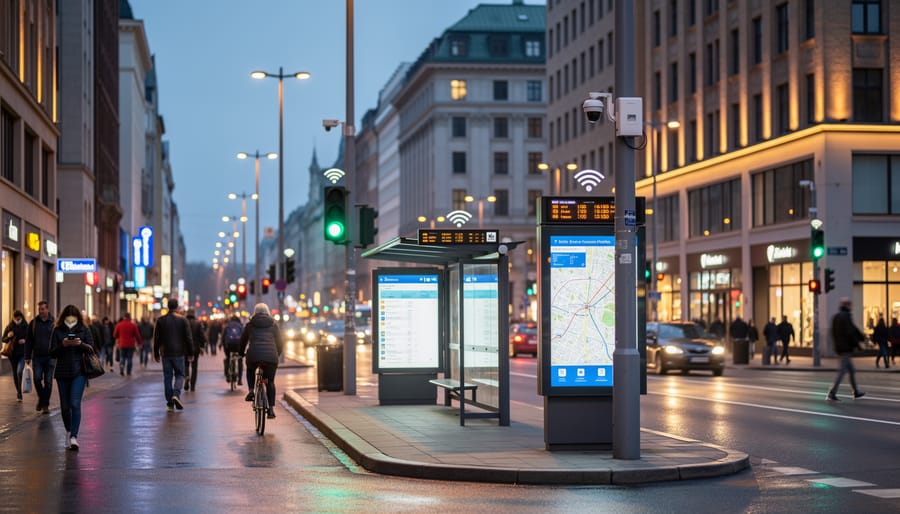
Kansas City’s Living Lab methodology transforms the city into a real-world testing ground where technologies are deployed, evaluated, and refined with active community input before wider implementation. Rather than building smart infrastructure in isolation, the model embeds experimental deployments along a 2.2-mile downtown streetcar corridor, chosen specifically for its diverse mix of residents, businesses, and visitors.
The approach operates through three iterative phases: deployment of prototype systems with transparent communication about what’s being tested, continuous data collection paired with structured community feedback sessions, and rapid iteration based on both technical performance metrics and citizen experience. For example, when testing smart kiosks, Kansas City gathered usage data alongside surveys about accessibility and relevance, adjusting both the smart city technology stack and placement based on actual behavior patterns.
Community participation isn’t an afterthought, residents join advisory committees, participate in design workshops, and provide ongoing feedback through digital platforms and in-person events. This co-creation model ensures technologies address genuine needs rather than presumed ones, while building public trust through transparency. The Living Lab generates evidence of what works in practice, not just theory, making Kansas City’s insights particularly valuable for Canadian cities seeking proven approaches before committing to full-scale deployments.
Data Governance and Privacy Framework
Kansas City established a comprehensive data governance framework that prioritizes citizen consent and transparency, principles that directly address Canadian privacy law requirements under PIPEDA and provincial legislation. The city publishes all data collection activities through a public registry that documents sensor locations, data types collected, retention periods, and intended uses. Citizens can access this registry online to understand exactly what information municipal systems gather in their neighborhoods.
The framework implements privacy-by-design protocols, ensuring that personally identifiable information is stripped from datasets before analysis. Aggregated, anonymized data feeds public dashboards showing traffic patterns, air quality readings, and service usage without compromising individual privacy. Kansas City formed a citizen advisory board that reviews proposed data collection initiatives and provides oversight on privacy protections, a governance structure that aligns with Canadian expectations for public accountability.
The city’s open data portal makes non-sensitive datasets available for researchers, developers, and entrepreneurs, fostering innovation while maintaining strict controls on protected information. Canadian municipalities adapting this model must navigate stricter provincial privacy regimes, but Kansas City’s layered approach, combining technical safeguards, public transparency, and citizen oversight, offers a proven template for building community trust in smart city data practices.
Key Components of the Kansas City Model
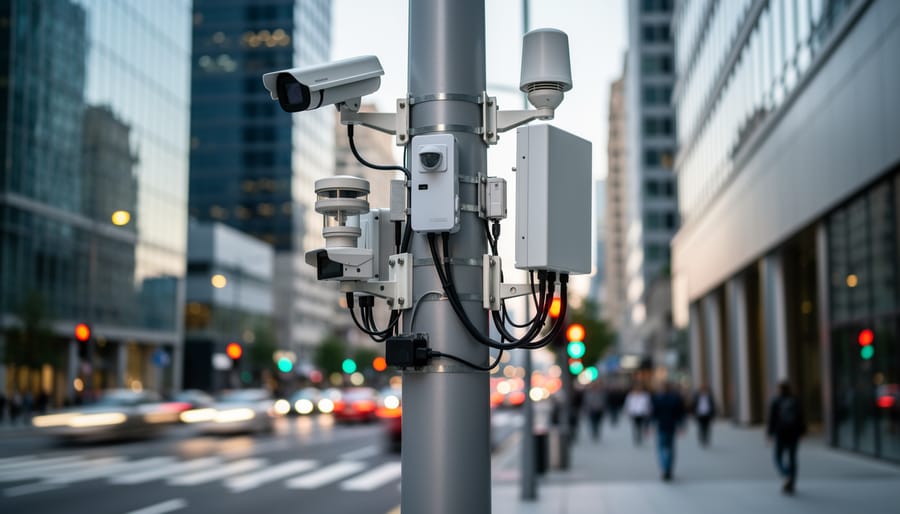
Kansas City’s smart city model operates through four interconnected components that work together to create a responsive urban ecosystem. Understanding these elements helps Canadian decision-makers identify which aspects translate most effectively to their municipal contexts.
The infrastructure layer forms the physical foundation of Kansas City’s approach. A 54-square-block downtown corridor houses over 125 sensors and connected devices embedded in streetlights, traffic signals, and public spaces. These sensors collect real-time data on pedestrian traffic, vehicle flow, air quality, and environmental conditions. The city deployed free public Wi-Fi across this corridor, establishing digital connectivity as a baseline service rather than a luxury. This infrastructure deliberately focuses on high-density areas first, allowing the city to demonstrate value before expanding to less concentrated neighborhoods.
Governance structures distinguish Kansas City’s model from top-down smart city implementations. The city established a Smart City Advisory Board comprising technology experts, community representatives, business leaders, and academic researchers. This board reviews proposed deployments, evaluates privacy implications, and ensures technology investments align with community priorities. Data governance protocols specify which information gets collected, how long it’s retained, and who can access it. The city publishes an annual transparency report detailing data usage and citizen impact metrics, creating accountability mechanisms that build public trust.
Partnership frameworks enable Kansas City to deploy technology without shouldering full financial burden. The city leveraged strategic relationships with private technology providers, creating pilot programs where companies test solutions in exchange for access to real-world deployment environments. Sprint, Cisco, and other firms contributed infrastructure and expertise, while the city retained ownership of collected data and decision-making authority over implementation priorities. These partnerships include sunset clauses and performance benchmarks, preventing vendor lock-in and ensuring municipal control.
Community engagement mechanisms ensure residents shape technology deployments rather than simply accepting them. Kansas City conducts regular community input sessions before implementing new sensor networks or digital services. The city provides plain-language explanations of proposed technologies, potential benefits, and privacy considerations. Residents can access collected data through public dashboards and request explanations for specific deployments. This participatory approach transforms citizens from passive subjects of monitoring into active stakeholders who influence which problems technology addresses and how solutions get designed.
These four components operate as an integrated system where infrastructure enables data collection, governance ensures responsible usage, partnerships provide resources, and community engagement maintains democratic accountability.
How Kansas City’s Strategies Apply to Canadian Smart Cities
Transportation and Mobility Solutions
Kansas City’s transportation initiatives demonstrate concrete approaches Canadian cities can adapt to mobility challenges across varying climates and urban densities. The city deployed smart parking sensors connected to real-time mobile apps, reducing congestion in downtown cores, a strategy particularly valuable for Canadian cities like Halifax or Saskatoon where winter weather already constrains parking availability. Transit optimization through GPS tracking and predictive analytics improved bus schedule reliability by 23%, addressing the service consistency issues that plague many Canadian systems during extreme weather conditions.
Pedestrian safety improvements used connected infrastructure and sensor data to identify high-risk intersections and adjust signal timing dynamically. These interventions reduced pedestrian incidents while accounting for seasonal traffic pattern shifts, a critical consideration for Canadian cities experiencing dramatic volume changes between summer tourism peaks and winter lulls. The key transferable element is Kansas City’s integration methodology: rather than deploying isolated technologies, they created interoperable smart city platforms where parking, transit, and safety data inform each other, enabling coordinated responses to mobility disruptions, whether snowstorms in Edmonton or construction season gridlock in Toronto.
Environmental Monitoring and Sustainability
Kansas City’s environmental monitoring infrastructure demonstrates concrete applications for Canada’s sustainability priorities, particularly in northern climate contexts where data-driven resource management addresses distinct challenges.
The city deployed a network of low-cost air quality sensors across neighborhoods, generating hyperlocal pollution data that revealed disparities traditional monitoring missed. For Canadian cities managing winter air quality issues, where wood-burning emissions and temperature inversions concentrate pollutants, this granular approach identifies problem zones and informs targeted interventions. Calgary and Edmonton have tested similar sensor arrays to track particulate matter during wildfire seasons.
Kansas City’s smart water infrastructure uses IoT sensors to detect leaks, monitor consumption patterns, and predict infrastructure failures before they occur. Canadian municipalities facing aging pipe networks and freeze-thaw cycles causing frequent breaks can adopt this predictive maintenance model. Winnipeg piloted comparable leak detection systems in 2024, reducing water loss by eighteen percent in trial areas.
Energy efficiency programs leveraged building sensors and real-time consumption analytics to reduce municipal energy use by twenty-two percent across participating facilities. For Canadian cities with heating costs dominating energy budgets, Kansas City’s approach to identifying inefficiencies and optimizing HVAC systems through automated controls offers measurable returns, especially when integrated with renewable energy targets many provinces have mandated.
Economic Development and Digital Inclusion
Kansas City’s economic development strategy centers on creating innovation districts that combine physical infrastructure with targeted digital inclusion programs. The city designated areas like the Crossroads Arts District and 18th & Vine corridor as technology zones, providing free gigabit internet access to stimulate entrepreneurship and attract tech companies. This model generated over $1.7 billion in economic development activity along the streetcar route while simultaneously addressing connectivity gaps in historically underserved neighborhoods.
The digital inclusion component proves particularly relevant for Canadian equity goals. Kansas City’s “Digital Stewards” program trained residents from low-income communities to become technology ambassadors, reducing the skills gap while creating local employment. The city partnered with community organizations to deploy free Wi-Fi in public housing and libraries, ensuring residents could access online education, telehealth services, and job opportunities.
For Canadian cities pursuing similar competitiveness objectives, Kansas City demonstrates how infrastructure investments can serve dual purposes. By linking innovation district development with explicit equity commitments, cities create economic growth that reaches beyond downtown cores. The approach requires patient capital and community partnerships, but yields measurable improvements in both business attraction and digital literacy rates.
Scalability Lessons for Canadian Cities
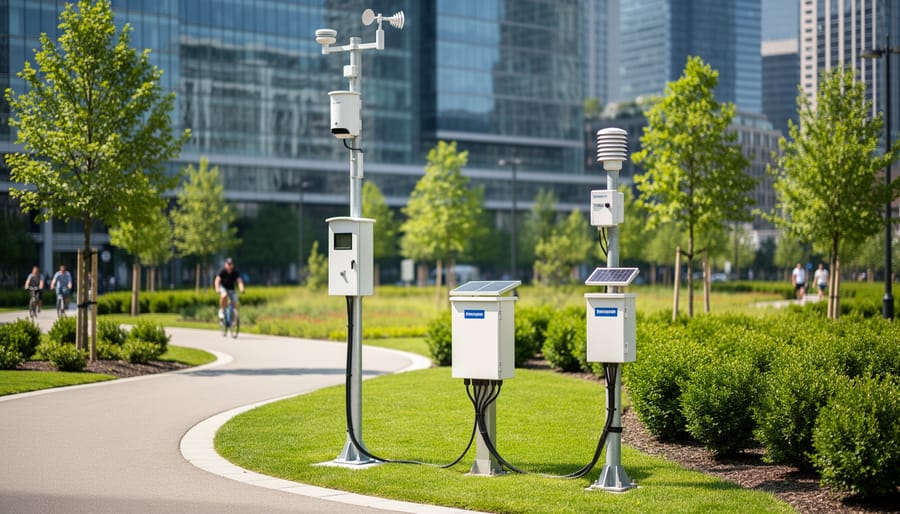
Kansas City’s experience reveals several critical scalability factors that Canadian municipalities must adapt rather than replicate. The most significant lesson is that successful scaling depends on modular infrastructure design aligned with existing municipal capacity and incremental funding availability, not wholesale technology adoption.
Funding models present the starkest contrast between American and Canadian contexts. Kansas City leveraged competitive federal grant programs and substantial private sector investment, while Canadian cities typically navigate split federal-provincial-municipal funding arrangements with longer approval timelines. Smaller Canadian municipalities, those under 100,000 residents, benefit most from shared-service models where regional technology cooperatives distribute infrastructure costs across multiple jurisdictions, a proven approach in Atlantic Canada and rural Ontario.
Climate considerations fundamentally alter infrastructure requirements. Kansas City’s temperate climate allows year-round sensor deployment and outdoor testing environments that northern Canadian cities cannot assume. Edmonton and Winnipeg have demonstrated that cold-weather sensor housing, battery performance at -40°C, and snow-removal coordination with IoT networks require specialized engineering and higher capital costs per deployment point. Canadian implementations must budget 15-20% additional infrastructure costs for climate-hardened equipment and seasonal maintenance protocols.
Regulatory frameworks differ substantially. Kansas City operates within a single state regulatory environment, while Canadian smart city initiatives navigate federal privacy legislation, provincial data governance rules, and municipal bylaws simultaneously. This layered compliance structure demands longer planning cycles but creates opportunities for reference architectures that satisfy multiple jurisdictional requirements from inception.
Population density variations across Canadian urban environments require flexible implementation strategies:
- Modular infrastructure design allowing component-by-component deployment
- Phased implementation strategies matching municipal budget cycles
- Public-private partnership structures with defined risk-sharing mechanisms
- Interoperability standards enabling vendor-neutral technology selection
- Community co-design processes ensuring citizen needs drive technology choices
Metropolitan areas like Toronto and Vancouver can deploy comprehensive sensor networks similar to Kansas City’s downtown corridor, while cities like Kelowna or Charlottetown achieve meaningful outcomes by focusing on single-domain solutions, smart parking or transit optimization, before expanding. The governance lesson is clear: Kansas City’s centralized municipal authority translates differently across Canada’s federal structure, where successful initiatives often emerge from inter-municipal collaborations and shared technology platforms rather than individual city deployments.
Collaborative Success Stories: Canadian Cities Learning from Kansas City
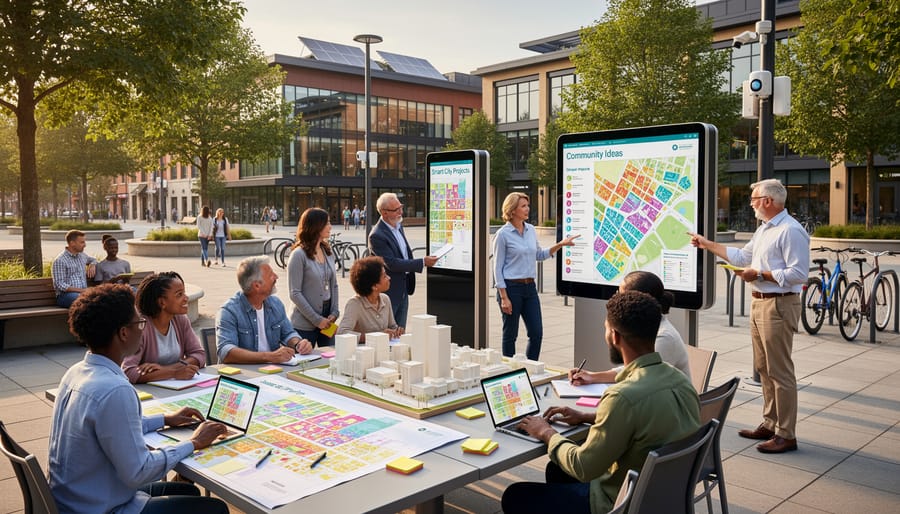
Edmonton’s Smart City Lab draws directly from Kansas City’s Living Lab methodology, establishing a 10-block innovation district in the downtown core where city staff test IoT sensors and citizen engagement platforms before citywide deployment. The partnership between the City of Edmonton, the University of Alberta, and local tech companies mirrors Kansas City’s public-private collaboration model. Since 2021, Edmonton has deployed 87 connected sensors monitoring air quality, pedestrian traffic, and waste management, data that informs infrastructure decisions and reduces operational costs by 18% in pilot areas.
Montreal adapted Kansas City’s open data governance framework when launching its Smart and Digital City strategy. The city consulted with KC Digital Drive leadership to develop transparent data-sharing protocols that balance innovation with privacy protection. Montreal’s approach includes citizen data councils, a concept refined from Kansas City’s community engagement structures, where residents review proposed data collection projects. This collaborative governance model has achieved 76% public support for smart city initiatives, compared to 52% before implementing community oversight mechanisms.
Surrey, British Columbia implemented Kansas City’s smart streetlight infrastructure in a phased deployment across three neighbourhoods. Working with BC Hydge and local IoT providers, Surrey installed 340 adaptive LED fixtures with integrated sensors that adjust lighting based on pedestrian presence and environmental conditions. The project reduced energy consumption by 41% while improving safety perception scores by 33%. Surrey’s procurement process incorporated lessons from Kansas City’s vendor partnership model, requiring technology providers to commit to three-year data interoperability standards.
Calgary’s Transit department studied Kansas City’s smart parking and mobility integration before launching its downtown congestion management system. The resulting platform connects parking availability data with real-time transit information, reducing vehicle circulation time by 23% in the core district. Calgary’s implementation team participated in knowledge-exchange sessions with Kansas City Metro officials, adapting their pedestrian safety protocols for Canadian winter conditions.
Common Questions About Implementing Kansas City’s Approach in Canada
Decision-makers evaluating Kansas City’s smart city framework for Canadian contexts consistently raise questions about practical adaptation. While the Living Lab methodology and partnership approach prove transferable, implementation details require adjustment for Canadian regulatory environments, climate realities, and funding mechanisms.
How do procurement rules differ between Kansas City and Canadian municipalities?
Canadian procurement typically follows more stringent public tendering requirements under provincial trade agreements and federal obligations, requiring longer RFP timelines and more extensive vendor evaluation processes than Kansas City’s streamlined approach. Many Canadian municipalities need council approval for technology pilots that Kansas City executes through administrative authority.
What climate adaptations are necessary for sensor infrastructure?
Canadian deployments require cold-hardened equipment rated for -40°C operation, weatherproof enclosures that prevent ice accumulation, and battery systems that maintain performance through winter temperature swings. Sensor placement must account for snow removal operations and reduced daylight hours during winter months.
How do funding models translate to Canadian fiscal structures?
While Kansas City leverages federal TIGER grants and state-level innovation funds, Canadian cities primarily access funding through federal Smart Cities Challenge awards, provincial infrastructure programs, and FCM’s Green Municipal Fund. Cost-sharing ratios typically differ, with Canadian projects requiring 30-40% municipal contribution versus Kansas City’s 20% match.
What timeline should Canadian cities expect for initial deployments?
Plan 18-24 months from concept to pilot launch, roughly six months longer than Kansas City’s timeline due to extended procurement cycles, bilingual stakeholder engagement requirements, and additional environmental assessment protocols under provincial legislation.
The regulatory landscape shapes implementation speed more than technical complexity. Canadian privacy laws require explicit consent mechanisms and data residency provisions that Kansas City’s framework doesn’t address. Municipalities should budget for legal review of data governance policies and plan phased rollouts that demonstrate compliance before scaling. Partner selection criteria must weigh domestic content requirements and regional economic development objectives alongside technical capability, factors that Kansas City’s partnerships don’t prioritize to the same degree.
Climate considerations extend beyond equipment specifications to maintenance protocols. Winter conditions demand year-round access plans for sensor networks, backup power systems during ice storms, and data validation routines that account for weather-related sensor occlusion. These operational realities increase ongoing costs by 15-25% compared to Kansas City’s temperate environment but prove essential for reliable year-round performance.
Kansas City’s smart city journey demonstrates that successful digital transformation is less about copying a template and more about adapting proven principles to local conditions. For Canadian municipalities, the value lies not in replicating Kansas City’s specific deployments but in learning from its methodological approach: test incrementally through living labs, prioritize citizen engagement from day one, build flexible public-private partnerships, and establish transparent data governance before scaling infrastructure.
The scalability lessons are clear. Smaller Canadian cities can start with focused pilots in single domains like smart parking or environmental monitoring, using Kansas City’s proof points to secure stakeholder buy-in. Mid-sized municipalities can leverage the Living Lab framework to de-risk technology investments while building community trust. Larger metros can adopt the partnership structures and open data platforms that allowed Kansas City to coordinate complex, multi-stakeholder initiatives across diverse neighborhoods.
What makes Kansas City’s experience particularly relevant is its emphasis on evidence over speculation. Canadian decision-makers benefit most by examining which specific components address their unique challenges, whether that’s extreme weather resilience, digital equity in remote areas, or bilingual citizen interfaces, and adapting accordingly. Smart city transformation succeeds when cities learn collaboratively, measure rigorously, and build infrastructure that serves people first.