
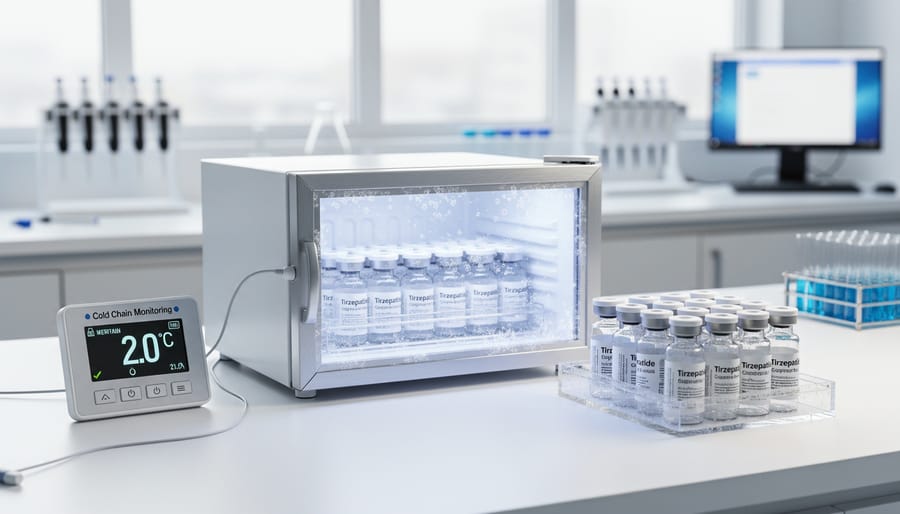
Store tirzepatide at the temperature on the manufacturer’s label or the supplier’s certificate of analysis, and for most research-grade lyophilized material that means refrigeration, protection from light, and no freezing unless the documentation says otherwise. The details matter because peptides degrade through hydrolysis, oxidation, and aggregation, and each of those pathways accelerates when temperature drifts. Moisture and repeated freeze-thaw cycles add further risk. Whether you’re receiving GLP 2 TZ peptide vials or any comparable peptide lot, the first control is the same: read the supplier’s storage statement before the shipment reaches the bench, and record it in your inventory system.
A single unlogged excursion can compromise weeks of work. A reconstituted vial left on a bench for an afternoon, or a freezer that cycles during a defrost, produces data nobody can fully trust. Teams that document storage conditions, set alarm thresholds, and define a deviation response in advance consistently report cleaner audits and fewer repeated assays.
This guide sets out the stability rationale, the conditions to confirm with your supplier, who needs a formal protocol, how monitoring responsibilities are assigned, and where to find authoritative help when a deviation occurs.
What Tirzepatide Storage Stability Means in a Lab Setting
Why Peptides Are Temperature-Sensitive
Peptides like tirzepatide are held together by chemical bonds and a delicate three-dimensional shape, and both respond quickly to their environment. Heat speeds nearly every reaction that damages them. Hydrolysis breaks peptide bonds and fragments the molecule. Oxidation alters susceptible side chains, and deamidation converts certain amino acid residues into different forms with altered behaviour. Aggregation is a physical problem: molecules clump together, which can reduce potency and cloud a solution that should be clear. The literature on protein and peptide degradation pathways describes how these routes interact and how formulation conditions influence each one.
Temperature is the dominant accelerant, but it is not the only one. Light can drive oxidation, which is why light protection appears alongside refrigeration. Vigorous shaking introduces air-liquid interfaces that promote aggregation, and freezing can stress the molecule through ice formation and concentration effects. Careful handling is therefore part of stability, not an optional extra.
Unopened, In-Use and Prepared Material: Different Rules Apply
A vial of tirzepatide does not carry a single set of storage rules for its whole life. Each state changes the risks, so each has its own conditions and time limits. An unopened, sealed container is protected by its original packaging and formulation. Once it is opened, punctured or diluted, new risks appear: contamination, oxidation, adsorption to surfaces and faster degradation. Prepared solutions are the most vulnerable.
For that reason, the controlling references are the product label, the supplier’s certificate of analysis and your internal SOP. Not a general rule of thumb. The table below shows where to confirm the limit for each state.
| Material state | Typical condition | Key precaution | Confirm the limit in |
|---|---|---|---|
| Unopened | Refrigerated, original container | Keep protected from light | Product label, supplier CoA |
| In-use | As specified by the manufacturer | Limit time out of refrigeration | Product label, internal SOP |
| Prepared solution | Defined by your validated procedure | Label with preparation date | Internal SOP, supplier guidance |
| Accidentally frozen | Quarantine pending assessment | Do not use until cleared | Manufacturer, QA office |
Where these sources conflict or are silent, escalate to the manufacturer or your quality office instead of assuming.
Recommended Storage Conditions: Temperature, Light and Container Notes
Day-to-Day Handling Practices That Protect Stability
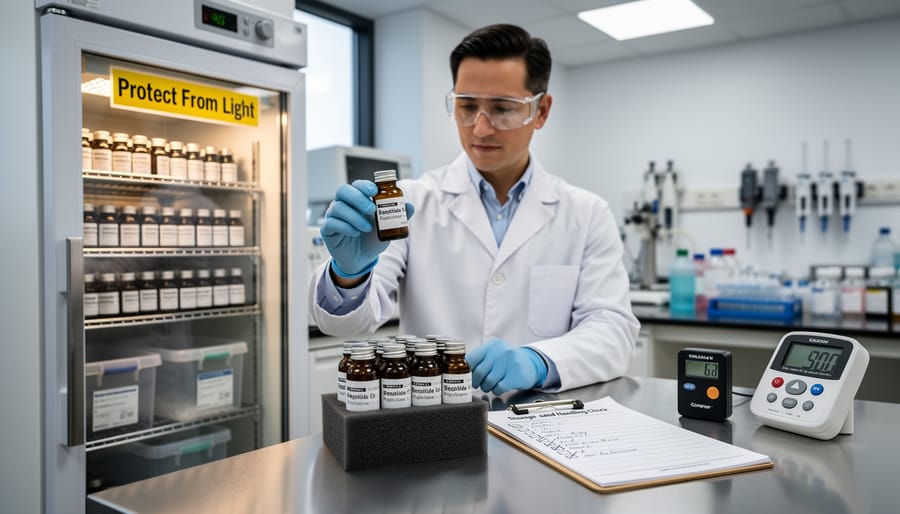
Stability is often lost at the bench rather than in the refrigerator. Small lapses in handling accumulate, and a vial that has been out of cold storage several times may look identical to one that has not. Building a few consistent habits into daily routines is the most reliable way to protect material between receipt and use.
Staff handling temperature-sensitive peptide material can work from a simple checklist:
- Remove only the quantity needed, and return it to refrigeration promptly after use.
- Keep material in its original container and packaging, away from direct light.
- Mix gently if required, and never shake vigorously, since agitation can promote aggregation.
- Do not freeze material, and avoid repeated temperature cycling.
- Log every removal and return with the date, time, initials and batch or lot reference.
- Quarantine and report any item left out of cold storage rather than quietly returning it to stock.
The last point matters most. A recorded removal that turns out to be harmless costs a minute of paperwork, while an unrecorded one can undermine an entire dataset. Where the label or supplier documentation gives a permitted time outside refrigeration, use that figure instead of an informal rule of thumb. If no such figure is available, treat the question as one for the manufacturer or your quality office, and keep the material separated until you have an answer.
Who Needs a Formal Storage Protocol: Eligibility and Scope of Lab Requirements
Not every lab storing tirzepatide faces the same obligations. Formal temperature-control requirements generally attach to institutional research labs, contract research organisations (CROs), teaching laboratories and any facility handling regulated or controlled materials. In practice, though, the deciding factor is rarely the type of building. It is the status of the material and what will be done with it.
Whether a documented protocol is required typically depends on these criteria:
- Material classification: regulated drug product, research-grade peptide or reference standard.
- Funding or regulatory conditions attached to the work, such as sponsor or agency quality expectations.
- Intended downstream use, from exploratory bench work to data supporting a regulatory submission.
- Institutional policy set by the biosafety, quality or compliance office.
The classification matters most. A regulated drug product usually comes with labelled storage conditions and may trigger formal chain-of-custody and deviation procedures. A research-grade peptide is often governed by the supplier’s certificate of analysis and the lab’s own quality system. A reference standard tends to demand the tightest controls, because it anchors the accuracy of every measurement made against it.
Roles matter too. Staff who receive, store, issue or dispose of material, along with those who review temperature records, generally need documented training and, where policy requires, formal authorisation. Principal investigators and lab managers are typically accountable for making sure that training happens and is recorded.
Because rules differ across institutions, funders and jurisdictions, avoid assuming a single universal standard. Confirm what applies to your material and your lab with your institution’s biosafety, quality or compliance office before setting your storage procedures.
Monitoring, Documentation and Responding to Temperature Excursions: Rights and Obligations
Building a Data-Driven Monitoring Routine
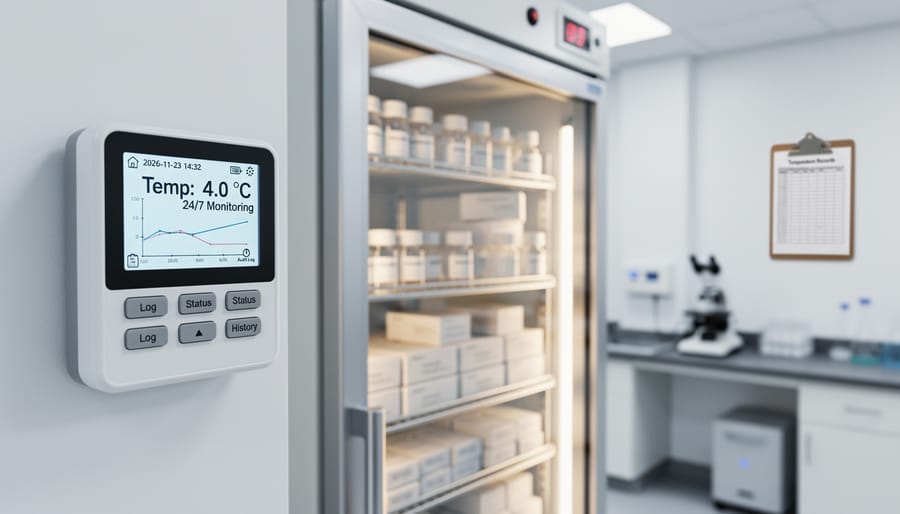
A monitoring routine only protects tirzepatide if it produces records someone can audit. Start with calibrated data loggers placed where the material actually sits, not near the door or cooling element, and set alarm thresholds inside the labelled storage range so staff get a warning before an excursion becomes a deviation. Alarms are only useful when someone is assigned to answer them, so name an owner and a backup for out-of-hours alerts.
Scheduled trend review is where a routine earns its keep. A weekly or monthly look at the logged data can show a door seal wearing out, a compressor cycling more often, or a unit drifting toward its limit well before an alarm fires. Periodic calibration of the sensors, with certificates kept on file, ties each reading back to a traceable reference. Together these steps give you a continuous, timestamped record that stands up in an audit.
Building and maintaining this record also depends on people. Digital monitoring and data-integrity practice are becoming core lab workforce skills and teams that train for them tend to avoid documentation failures that undermine otherwise sound storage. For broader context on monitoring and trends in the digital economy, see TRLabs’ latest update.
Common Questions About Tirzepatide Lab Storage
Can tirzepatide that was accidentally frozen still be used?
Freezing is generally treated as a storage failure for tirzepatide, and the label usually says not to use material that has frozen. Quarantine it and ask the manufacturer or your quality office for a documented decision rather than judging it by appearance.
How long can material sit at room temperature?
The permitted time out of refrigeration differs by product, presentation and in-use status, so there is no safe general figure. Check the label or supplier documentation, and record any excursion in your deviation log.
Does light protection really matter?
Yes, as a precaution. Keeping vials or pens in their original packaging limits light exposure, and the label will state whether that protection is required.
How should prepared or diluted solutions be stored?
Prepared solutions follow their own conditions and time limits, which are usually shorter than those for unopened material. Rely on the manufacturer’s documentation or your lab’s qualified stability data, and label each preparation with its date and time.
What records will an audit expect?
Auditors typically look for temperature logs, calibration certificates, chain-of-custody labels, removal and return entries, and deviation reports. Keep these linked to the batch or lot number so the storage history can be reconstructed.
When none of these answers settles your situation, escalate in a set order: first the product label and manufacturer technical support, then the supplier’s certificate of analysis, then your institution’s quality or biosafety office. Written SOPs help staff follow that path consistently, and the same habit makes audits less stressful. Many labs build this discipline through shared training and capacity-building programs that bring documentation and monitoring skills into everyday practice, so that decisions about borderline material rest on records rather than recollection.
Where to Get Help: Suppliers, Regulators and Training Partners
When a storage question goes beyond what your SOP covers, the fastest route to an answer is usually the document or office closest to the material. Start with the product label and the manufacturer’s technical support line, because stability limits for a specific presentation belong to the company that tested it. Generic rules rarely settle an excursion question.
Each source answers a different kind of question:
- Manufacturer technical support: confirms storage conditions, in-use periods and any available excursion data for a specific product.
- Supplier certificate of analysis: documents purity, identity and recommended storage for the exact lot you received.
- Institutional quality assurance or biosafety office: clarifies which internal procedures, authorisations and deviation-reporting steps apply to your lab.
- National regulators and pharmacopoeial guidance: set out the formal expectations for handling, documentation and quality of regulated materials.
- Training and upskilling programmes: build staff skills in cold-chain handling, data logging and data integrity.
Regulatory and pharmacopoeial sources matter most when your work touches regulated drug products or contract research. Check whether your jurisdiction’s regulator publishes guidance on storage and temperature control, and ask your compliance office which standards your institution has formally adopted.
Reliable storage is also a shared capability, not just a freezer setting. Partnerships between laboratories, educational institutions, industry and government help turn individual good practice into common standards, and they give technicians and researchers somewhere to build monitoring, documentation and data-handling skills. That kind of collaboration is part of what underpins a broader smart future reliability for research infrastructure. If you are unsure where to begin, your institution’s QA office can usually point you to approved training routes and the right technical contacts.
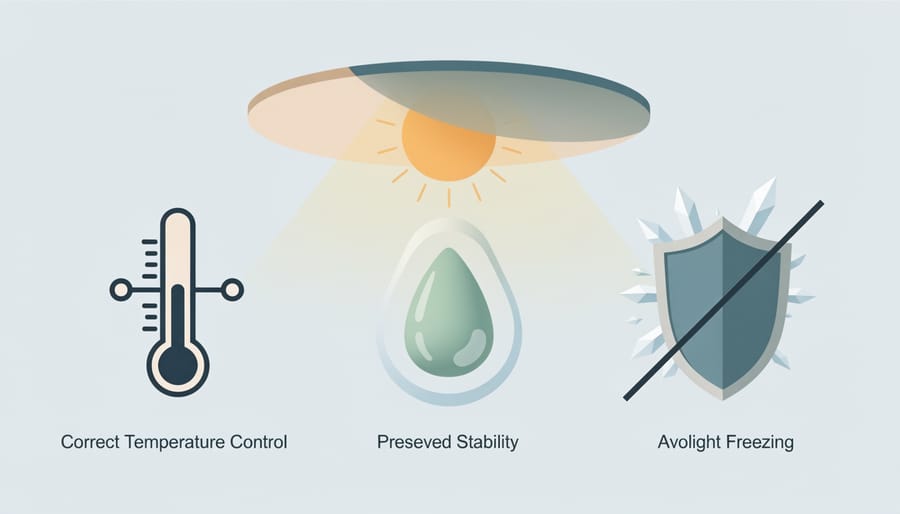
Reliable tirzepatide storage comes down to a short list of habits that, practiced consistently, protect both your material and your data. Follow the product label and supplier documentation first. Keep the material in its original container, protected from light, and avoid freezing it or handling it more than necessary. Track temperature continuously, record every removal and return, and route any deviation through a written process rather than a quick judgment call.
None of this requires exotic equipment. It requires clear procedures, trained people and records that someone can audit months later. Labs that invest in those basics tend to spend less time second-guessing their results, because they can show exactly how each vial was kept.
There is also a broader opportunity here. As monitoring moves toward connected data loggers and automated alerts, skills in data integrity and digital record-keeping become as valuable as bench technique. Shared standards, built through partnerships among laboratories, universities, industry and regulators, help every team raise its practice together. Strong documentation and steady skills development are what make research findings dependable and repeatable.